


Hey there! I'm a supplier of honeycomb paper, and I'm super excited to take you behind the scenes to show you how this amazing material is made. Honeycomb paper is not only eco - friendly but also has a wide range of applications, from packaging to construction. So, let's dive right in!
The Basics of Honeycomb Paper
First off, what exactly is honeycomb paper? Well, it's a type of paper product that has a structure similar to a honeycomb. This unique structure gives it excellent strength - to - weight ratio, making it very useful for many purposes. You can find it in different forms, like Honeycomb Paper Roll, 3D Honeycomb Paper Mat, and Honeycomb Paper In Sheets.
Raw Materials
The main raw material for honeycomb paper is, of course, paper. Usually, kraft paper is used because it's strong and durable. Kraft paper is made from wood pulp, which is a renewable resource. This makes honeycomb paper an environmentally friendly choice. Some manufacturers might also add other additives to enhance the paper's properties, like water - resistance or fire - retardancy, depending on the end - use of the honeycomb paper.
The Manufacturing Process
Step 1: Paper Preparation
The first step in making honeycomb paper is to prepare the paper. The kraft paper is unrolled from large reels and then cut into appropriate widths. The width depends on the size of the honeycomb structure that you want to create. The paper is also treated to make sure it has the right moisture content. If the paper is too dry, it can become brittle and break during the manufacturing process. On the other hand, if it's too wet, it won't form the honeycomb structure properly.
Step 2: Applying Adhesive
Once the paper is prepared, an adhesive is applied to it. The adhesive is a crucial part of the process because it holds the honeycomb structure together. There are different types of adhesives that can be used, such as water - based adhesives or hot - melt adhesives. Water - based adhesives are more environmentally friendly, while hot - melt adhesives offer faster bonding times.
The adhesive is applied in a specific pattern on the paper. Usually, it's applied in parallel lines at regular intervals. The distance between the lines determines the size of the honeycomb cells.
Step 3: Folding the Paper
After the adhesive is applied, the paper is folded. This is done using a special folding machine. The machine folds the paper back and forth along the lines where the adhesive was applied. As the paper is folded, the adhesive bonds the layers together, creating the honeycomb structure.
The folding process needs to be precise. If the folds are not straight or if the adhesive doesn't bond properly, the honeycomb structure might not be strong enough. The machine can be adjusted to create different cell sizes and shapes, depending on the requirements of the final product.
Step 4: Expansion
Once the paper is folded and bonded, the honeycomb structure is expanded. This is done by pulling the folded paper apart gently. As the paper is pulled, the honeycomb cells open up, creating the characteristic hexagonal shape.
The expansion process is carefully controlled to make sure that the cells are evenly sized and that the honeycomb structure is uniform. If the expansion is too fast or too uneven, the cells might collapse or the structure might become distorted.
Step 5: Cutting and Finishing
After the honeycomb structure is expanded, it's cut into the desired sizes and shapes. This can be done using a cutter or a saw, depending on the thickness and density of the honeycomb paper.
The cut honeycomb paper might also go through some finishing processes. For example, it might be laminated with another layer of paper or film to improve its appearance or performance. Laminating can also add extra strength or water - resistance to the honeycomb paper.
Quality Control
Throughout the manufacturing process, quality control is essential. There are several checks that are done to make sure that the honeycomb paper meets the required standards.
The strength of the honeycomb paper is tested using various methods. For example, a sample of the paper might be subjected to a compression test to see how much weight it can bear before collapsing. The size and shape of the honeycomb cells are also checked to make sure they are within the specified tolerances.
The adhesive bond is also inspected to ensure that it's strong enough. If the bond is weak, the honeycomb structure might come apart during use.

Applications of Honeycomb Paper
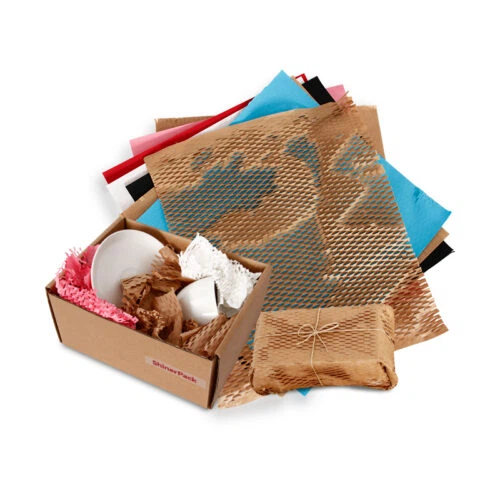
Honeycomb paper has a wide range of applications. In the packaging industry, it's used as a cushioning material to protect fragile items during shipping. The honeycomb structure absorbs shock and provides excellent protection. You can use Honeycomb Paper Roll to wrap items or 3D Honeycomb Paper Mat as a liner in boxes.
In the construction industry, honeycomb paper can be used as an insulation material. Its honeycomb structure traps air, which helps to reduce heat transfer. It can also be used as a lightweight core material in sandwich panels.
In the furniture industry, honeycomb paper can be used to make lightweight and strong furniture parts. For example, it can be used as a core material for tabletops or cabinet doors.
Why Choose Our Honeycomb Paper
As a honeycomb paper supplier, we take pride in our products. We use high - quality raw materials and state - of - the - art manufacturing processes to ensure that our honeycomb paper is of the highest quality.
Our honeycomb paper is available in a variety of cell sizes, thicknesses, and densities to meet your specific needs. Whether you need it for packaging, construction, or furniture, we have the right product for you.
We also offer excellent customer service. Our team is always ready to answer your questions and help you choose the best honeycomb paper for your application.
If you're interested in purchasing honeycomb paper, we'd love to hear from you. Whether you're a small business or a large corporation, we can provide you with the honeycomb paper you need at a competitive price. Just reach out to us, and we can start discussing your requirements and how we can meet them in the best way possible. Let's work together to find the perfect honeycomb paper solution for your business!
References
- Smith, J. (2020). The Manufacturing of Paper Products. Publisher: PaperTech Press.
- Brown, A. (2019). Applications of Honeycomb Structures. Journal of Materials Science, 15(3), 123 - 135.


